by Admin | Oct 9, 2020 | Chronicles
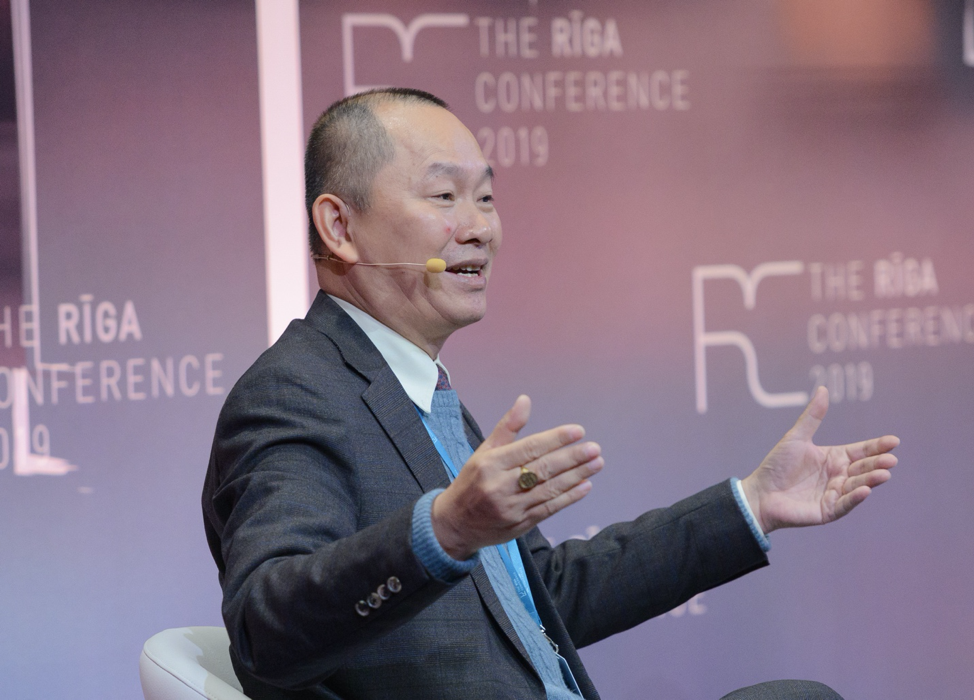
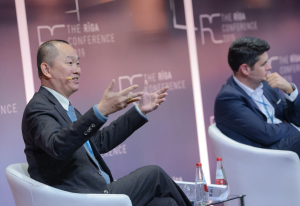
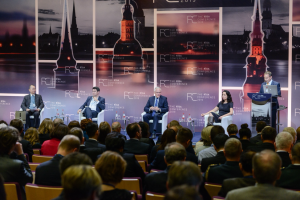
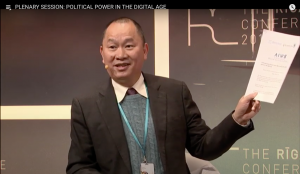
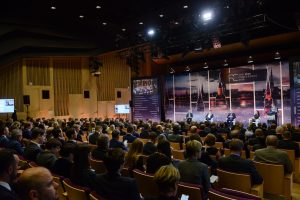
Nguyen Anh Tuan, CEO of the Boston Global Forum, was a speaker at the Riga Conference 2019 at the Plenary Session “Political Power in the Digital Age”. Mr. Tuan introduced the AIWS Social Contract 2020. This was after the AIWS Conference at Harvard University Faculty Club, September 23, 2019, discussing the concepts of the AIWS Social Contract 2020, the previous name given to the Social Contract for the AI Age. This was the first international conference outside the United States that the Social Contract for the AI Age was introduced.
Leaders such as Speaker of Sweden Parliament, Prime Minister of Ukraine, Minister of Defense of Germany, President and Prime Minister of Latvia, and global distinguished thinkers, spoke at The Riga Conference 2019.
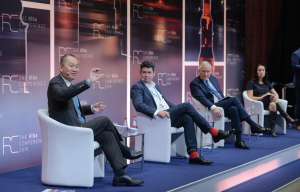
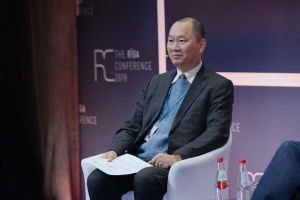
Here are pictures from Mr. Nguyen Anh Tuan’s presentation of the Social Contract for the AI Age at the Riga Conference 2019:
by Admin | Oct 23, 2020 | Chronicles, News
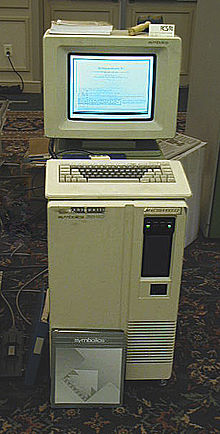
This week in The History of AI at AIWS.net – the sudden collapse of the market for specialised AI hardware in 1987. This is due to the fact that computers from Apple and IBM became more powerful than Lisp machines and other expert systems. In the 80s, specialised AI hardware such as Lisp machines became very popular due to its effectiveness in the corporate world. However they were expensive to maintain. By the end of the decade, computers by Apple and IBM had catched up with expert systems, per Moore’s Law, and also at a far cheaper price. Because now consumers no longer require the more expensive expert systems, there was a collapse for the market of such things.
This collapse of the market led to what is dubbed the Second AI Winter. The collapse coincided with the end of the 5th Generation Computer project of Japan and the Strategic Computing Initiative in the USA. The expensive nature of expert systems and the lack of demand led to slowdowns in development of that field. Companies that run Lisp went bankrupt or moved away from the field entirely. Thus, the winter spelled the end for expert systems as a major player in AI and computers.
Expert systems are computer systems that can emulate man’s decision-making abilities. They are designed to solve problems through reasoning adn they can perform at the level of human experts. The first expert system was SAINT, developed by Marvin Minsky and James Robert Slagle. Lisp machines are designed to be able to run expert systems. Lisp machine runs the Lisp programming language, and in a way, it was one of the first commercial and personal workstation computer.
The fall of expert systems highlight lessons that are valuable for the History of AI and the current development of AI as well. It shows the failure to adapt by many in the AI field. The end of expert system in popular usage and the beginnings of the Second AI winter are also important milestones in the development of Artificial Intelligence. Thus, the HAI initiative considers this event an important marker in the history of AI.
by Admin | Oct 3, 2020 | Chronicles
The Social Contract for the AI Age was officially launched and discussed at World Leadership Alliance-Club de Madrid Policy Lab “Transatlantic Approaches: A New Social Contract in the Age of AI” during September 16-18, 2020, with the attendance of presidents, prime ministers, distinguished thinkers, policymakers, and senior officials.
Starting this week, AIWS.net will introduce historical conferences of the Social Contract for the AI Age.
In this AIWS Weekly, we introduce the first conference of Social Contract for the AI Age.
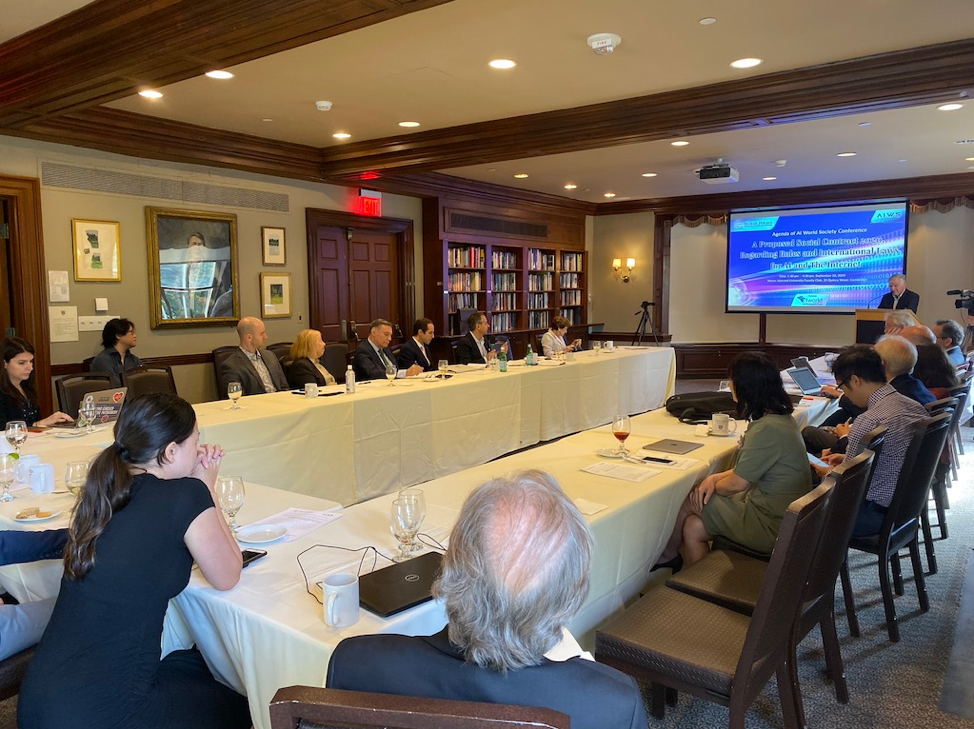
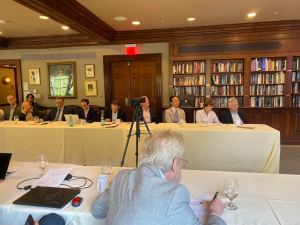
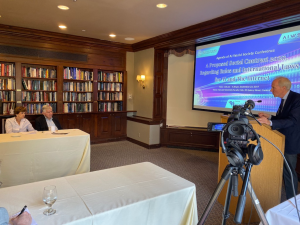
On September 23, 2019, at the Harvard University Faculty Club, Boston Global Forum organized the AIWS conference “A Proposed Social Contract 2020, Regarding Rules and International Laws for AI and the Internet”
Agenda and Speakers:
Opening Remarks Governor Michael Dukakis, Chairman of Boston Global Forum
Concepts of the Social Contract 2020 Professor Alex ‘Sandy’ Pentland, MIT
Solutions for AI Transparency: Professor Christo Wilson, Northeastern University,
Rules and International Laws of AI World Society
Mr. Paul Nemitz, Principal Adviser, Directorate General for Justice and Consumers, the European Commission
Mr. Michel Servoz, Special Adviser to the President of the European Commission
Mr. Nam Pham, Assistant Secretary for Business Development & International Trade, State of Massachusetts
Participants:
Prof. Nazli Choucri, MIT
Ms. Kitty Dukakis, First Lady of Massachusetts
Prof. Thomas Patterson, Harvard Kennedy School
Prof. David Silbersweig, Harvard Medical School
Mr. Nguyen Anh Tuan, the Boston Global Forum,
Prof. Thomas Creely, U.S. Naval War College
Mr. Allan Cytryn, Former CTO, Goldman Sachs,
Prof. Hiroshi ESAKI, the University of Tokyo
Prof. Rosabeth Kanter, Harvard Business School
Ms. Rebecca Leeper, Computer Ethics and Data Policy Advocator
Mr. Jamil Mahuah, Former President of Ecuador, Visiting Faculty, Harvard Kennedy School
Mr. Barry Nolan, Senior Advisor of Joint Economic Committee, U.S. Congressional
Ms. Elizabeth Renieris, Berkman Klein Center Fellow, Harvard
Mr. Jeff Saviano, EY Global Tax Innovation Leader, MIT Connection Science Fellow
Mr. Thomas Vallely, Founder of the Fulbright University, Director of Vietnam Program at Harvard
In the conference, speakers and participants discuss concepts from the Social Contract 2020. The original name of the Social Contract for the AI Age is the AIWS Social Contract 2020. Mr. Nguyen Anh Tuan would go on and speak about the AIWS Social Contract 2020 at the Riga Conference 2019, 11-12 October 2019 in Riga, Latvia.
by Admin | Oct 16, 2020 | Chronicles, News
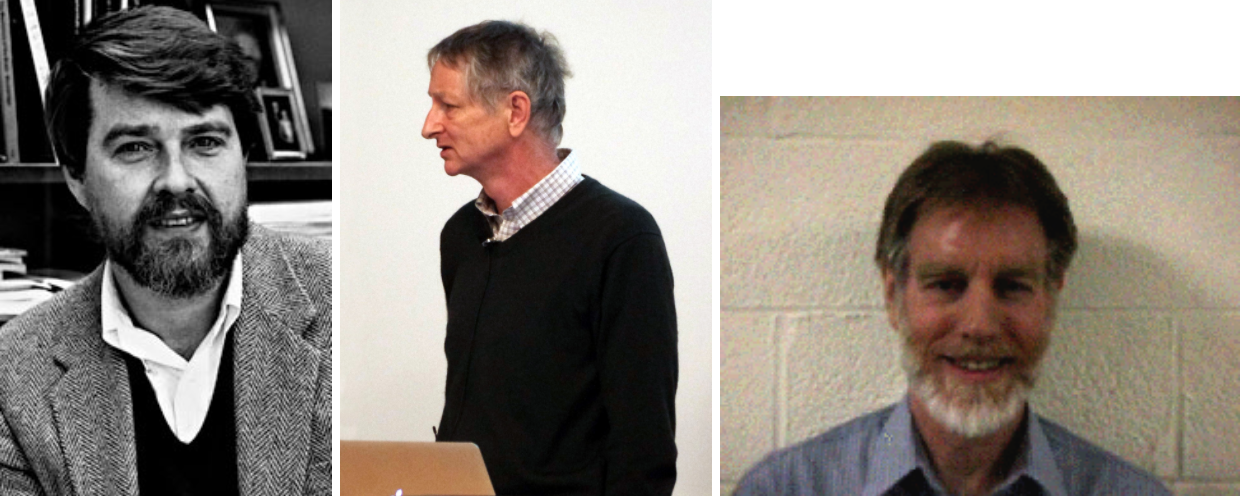
This week in The History of AI at AIWS.net – David Rumelhart, Geoffrey Hinton, and Ronald Williams published “Learning representations by back-propagating errors” in October 1986. In this paper, they describe “a new learning procedure, back-propagation, for networks of neurone-like units.” The term backpropagation was introduced in this paper, and the concept of it was also introduced to neural networks. The paper can be found here.
David E. Rumelhart was an American psychologist. He is notable for his contributions to the study of human cognition, in terms of mathematical psychology, symbolic artificial intelligence, and connectionism. At the time of publication of the paper (1986), he was a Professor at the Department of Psychology at University of California, San Diego. In 1987, he then moved to Stanford, becoming Professor there until 1998. Rumelhart also received the MacArthur Fellowship in 1987, and was elected to the National Academy of Sciences in 1991.
Geoffrey Hinton is an English-Canadian cognitive psychologist and computer scientist. He is most notable for his work on neural networks. He is also known for his work into Deep Learning. Hinton, along with Yoshua Bengio and Yann LeCun (who was a postdoctorate student of Hinton), are considered the “Fathers of Deep Learning”. They were awarded the 2018 ACM Turing Award, considered the Nobel Prize of Computer Science, for their work on deep learning.
Ronald Williams is a computer scientist and a pioneer into neural networks. He is a Professor of Computer Science at Northeastern University. He was an author on the paper “Learning representations by back-propagating errors”, and he also made contributions to recurrent neural networks and reinforcement learning.
The History of AI Initiative considers this paper important because it introduces backpropagandation. Furthermore, the paper created a boom in research into neural network, a component of AI. Geoffrey Hinton, one of the authors of the paper, would also go on and play an important role in Deep Learning, which is a field of Machine Learning, part of Artificial Intelligence.
by Admin | Oct 9, 2020 | Chronicles, News
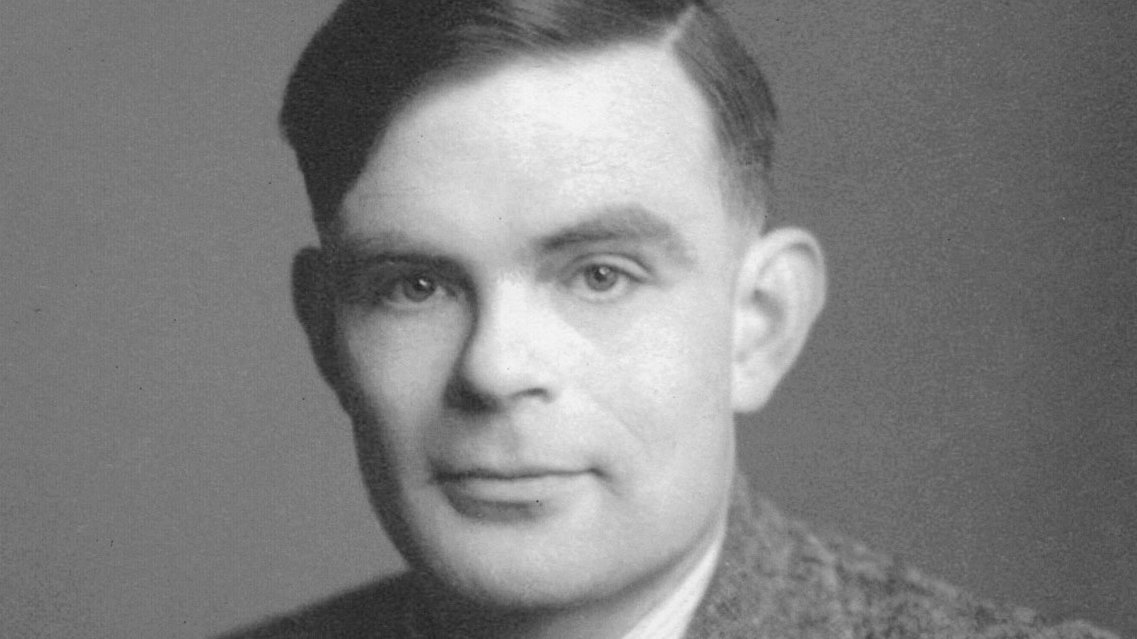
This week in The History of AI at AIWS.net – “Computing Machinery and Intelligence” by Alan Turing was published in the Mind quarterly academic journal in October 1950. It was the first instance that the “Turing test” was introduced to the public. The paper takes the question “Can machines think” and breaks it down. The paper also addresses 9 objections and arguments against Artificial Intelligence – Religious, “Heads in the Sands”, Mathematical, etc. Turing wrote about a potential “Learning Machine” that could successfully bypass the Turing test.
The Turing test, also known as the Imitation game, can be used to tell machines from humans. It poses a hypothetical, where a human evaluator would judge conversations between a machine designed for human-like responses and a human; if the evaluator cannot identify the machine from the human, then the machine passed the test. The test has proven to be both influential and controversial.
Alan Turing was a British computer scientist and cryptanalyst. He developed the Turing machine, a model of a general-purpose computer, in 1936. During the Second World War, he worked at Bletchley Park (Government Code and Cyper School) as a codebreaker for the United Kingdom. At his time here, he would play a critical role in solving Enigma, Germany’s wartime infamous encryption system. Solving Enigma helped turning the tide of the war in favour of the Allies. After the war, he would go on to develop the Turing test in 1950. Alan Turing is widely considered the father of modern Artificial Intelligence, as well as being highly influential in theoretical computer science. The “Nobel Prize of Computing”, the ACM Turing Award, is named after him.
The History of AI initiative considers this event to be important due to “Computing Machinery and Intelligence” being a seminal paper in regards to both Computer Science and AI. The paper introduces many new concepts in CS and AI to the general public. Alan Turing is a pivotal figure in the development of Artificial Intelligence, computing, and machine learning as well. Thus, the publication of this paper is a critical moment in the History of AI.