by Admin | Feb 11, 2022 | Chronicles, News
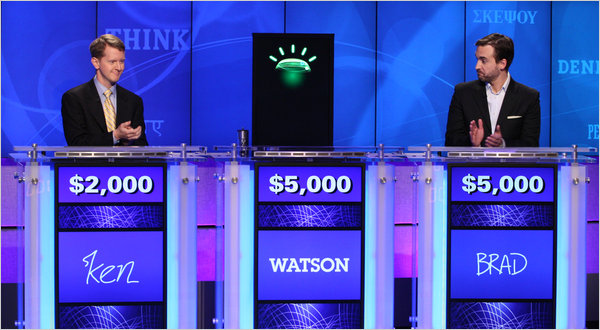
This week in The History of AI at AIWS.net – IBM “Watson” machine defeats 2 human Jeopardy! champions. The machine went on the show on February 16th, 2011 and faced off against Ken Jennings and Brad Rutter, previous winners of the famous game-show.
The show was taped in Janaury of 2011 but was not aired until February of the same year. Instead of a regular episode, this showdown was played out over three parts, concluding on February 16th. It was filmed at one of IBM’s research lab. More than just a publicity and PR display, it was a vindication of the progress Artificial Intelligence has made in the past decades.
“Watson” is a question-answering computer system, developed by IBM as a part of their DeepQA project. David Ferrucci, an American biologist and computer scientist, headed the development of Watson as principle investigator with a research team. Watson is named after IBM’s founder and first leader, Thomas J. Watson. After its success on Jeopardy, Watson was first utilised in helping lung cancer treatment at the Memorial Sloan Kettering Cancer Center in New York City.
The New York Times covered this event on its website. The article can be read here. A clip of Watson’s victory can be viewed here.
The HAI initative considers this an important development in the history of AI due to its publicity and notability as the culmination of a research project in artificial intelligence.
by Admin | Feb 6, 2022 | Chronicles, News
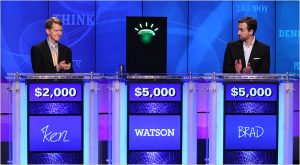
This week in The History of AI at AIWS.net – Edward Feigenbaum formally introduces expert systems in 1965. He was a part of the Stanford Heuristic Programming Project, which contained other notable AI pioneers.
Edward Feigenbaum is an American computer scientist focused on Artificial Intelligence. He studied at Carnegie Mellon University for both his B.S. and Ph.D., with Herbert Simon, an AI pioneer, as his doctoral advisor. He would go on to work at UC Berkeley and Stanford, the latter where he became Professor Emeritus of Computer Science (since 2000). Feigenbaum received the ACM Turing Award in 1994 with Raj Reddy for pioneering in AI and demonstrating its commercial potential.
The Stanford Heuristic Programming Project included members outside of Edward Feigenbaum such as Bruce G. Buchanan, Joshua Lederberg, and Carl Djerassi. They are most notable for the MYCIN experiments. Many of their papers and research can be read here.
Expert systems would become the basis for future AI products and developments. Furthermore, the members who were a part of this project would also work on other pioneering projects in A. Thus, the HAI initiative sees this event as a marker in the history of AI.
by Admin | Jan 30, 2022 | Chronicles, News
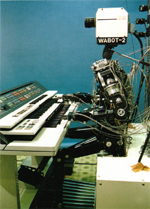
This week in The History of AI at AIWS.net – Waseda University built WABOT-2 in 1984. A follow up to the WABOT-1 they built in 1973, this robot was also anthropomorphic, but improvements were made.
The WABOT-2 was a follow-up to the WABOT-1 project. This iteration can now play music of average difficulty on an electronic organ. It was now able to converse with another person as well. In addition, it now has a camera for its head. A contrast with WABOT-1 is that WABOT-2 is considered a “specialist robot” instead of a “versatile robot”.
After the success of WABOT-1 in 1973, Waseda University picked the project back up in 1980. The project developed by a study group at the School of Science & Engineering. The goal of this project was to create an anthropomorphic robot that could perform intelligent tasks such as performing music. Thus, WABOT-2 became more specialised, rather than the versatility of WABOT-1
Similar to the WABOT-1, WABOT-2 was mainly a robotic project. Still, the WABOT-2 helped develop AI in improving the WABOT’s ability to conversate. The HAI initiative considers this an event, as with the first one, in the History of AI due to its contributions to the development of AI.
by Admin | Jan 21, 2022 | Chronicles, News
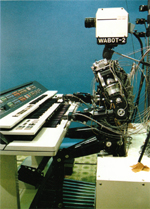
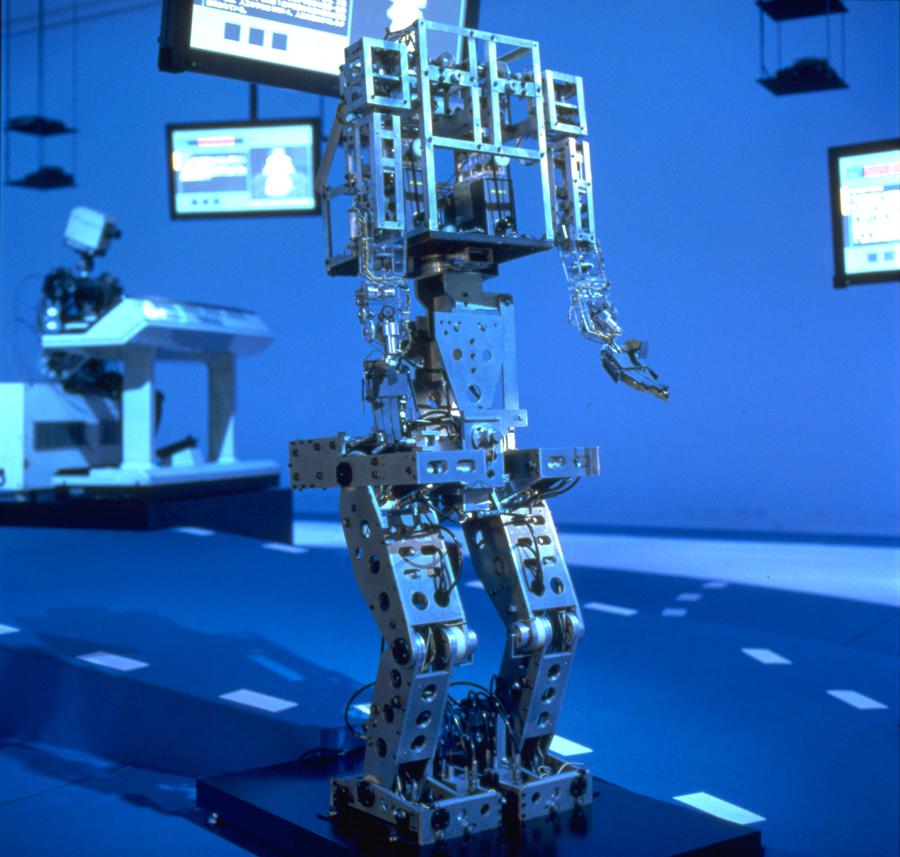
This week in The History of AI at AIWS.net – Waseda University built WABOT-1 in 1973. It was the first full-scale anthropomorphic robot, with a climb-control system, a vision system, and a conversation system.
The WABOT-1 was the first of its kind. It was able to communicate with a person in Japanese, as well as measure distance and direction. WABOT (WAseda roBOT) was able to walk and grab objects. It had the mental faculty of a one-and-a-half-year-old child. The robot had the WAM-4 for its hands, and the WL-5 for its legs.
The WABOT project was initiatived at Waseda University in Tokyo, Japan in 1967. Development did not fully start until 1970, and was not finished until 1973. The project was under the direction of Ichiro Kato at the School of Science & Engineering. In the 80s, Waseda University would reiterate its works on WABOT-1 with a new robot, the WABOT-2.
While the WABOT-1 was a mainly robotic project, its conversation system creates for it an important connection to the field of AI. The HAI initiative considers this an event in the History of AI due to its contributions to the development of AI.
by Admin | Jan 15, 2022 | Chronicles, News
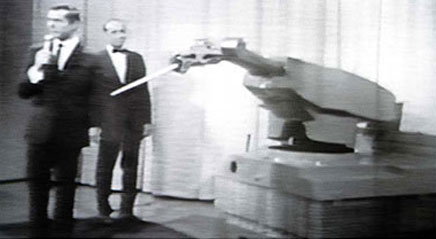
This week in The History of AI at AIWS.net – Unimate, an industrial robot developed in the 50s, becomes the first to work in New Jersey in 1961.
Unimate was invented by George Davol, who filed the patent in 1954. Davol met Joseph Engelberger in 1956, and the two paired up to found Unimation, the first robot manufacturing company. Davol and Engelberger promoted Unimate at The Tonight Show. Engelberger then exported industrial robotics to outside the US as well.
The Unimate worked at a General Motors assembly line at the Inland Fisher Guide Plant in New Jersey. The robot transported die castings from asssembly lines and welded parts on autos. It did this job because it was considered dangerous for human workers, due workplace hazards such as toxic fumes. The robot had the appearance of a box connected to an arm, with systematic tasks stored in a drum memory.
Although this machine was not directly connected to Artificial Intelligence, it was a precursor to developments in that field. By implementing a robot that can do tasks, this project was taking the first steps towards AI. Thus, the HAI initiatve considers this a milestone in the History of AI.