
by Admin | Jan 8, 2021 | Chronicles, News
This week in The History of AI at AIWS.net – Joseph Weizenbaum was born on January 8th, 1923. Weizenbaum published the program ELIZA in 1966 which could mimic conversation with humans. Although Weizenbaum was considered a father of Artificial Intelligence, he criticised the field later in his life.
Joseph Weizenbaum was a German-American computer scientist. He was born in 1923 to Jewish parents in Germany and fled to the US in 1936. He studied at Wayne State University, which was interrupted by the outbreak of the Second World War, but he completed his B.S. there in 1946 and M.S. in 1950. He started working at MIT in 1964. There he developed ELIZA. In the 70s and 80s he casted some doubts on AI and computer, with his book Computer Power and Human Reason (1976) and an interview with MIT’s The Tech. In 2008, the International Society for Ethics and Information Technology established the Weizenbaum Award, named after him, for individuals that made significant contributions to information and computer ethics. Weizenbaum passed away in Germany in 2008.
ELIZA was a computer program developed at the MIT AI Lab between 1964 and 1966. It was named after the character Eliza Doolittle from the play Pygmalion by George Bernard Shaw. The program runs a DOCTOR script, and acts in the manner of a psychotherapist. ELIZA could simulate a conversation but wasn’t able to contextualised them. Weizenbaum’s purpose of developing the program was to demonstrate the superficiality of communication between humans and machines. ELIZA is one of the first examples of a chatbot.
Joseph Weizenbaum was a pivotal figure in the development of AI with his contribution of ELZIA. Thus, the HAI Initiative considers his birth to be a notable event in the history of AI.

by Admin | Jan 1, 2021 | Chronicles, News
Yesterday, the HAI board and initiative announced the HAI 2020 awards and nominations which can be read here in full.
This week in The History of AI at AIWS.net – the end of the first AI Winter in 1980. This was due to the adoption of “expert systems” into corporations in the 90s and Japan’s Fifth Generation Computer project.
Expert systems are computer systems that can emulate man’s decision-making abilities. They are designed to solve problems through reasoning and they can perform at the level of human experts. The first expert system was SAINT, developed by Marvin Minsky and James Robert Slagle. Lisp machines are designed to be able to run expert systems. Lisp machine runs the Lisp programming language, and in a way, it was one of the first commercial and personal workstation computer.
Japan’s Fifth Generation Computer program was created and funded by the Japanese Ministry of Trade and Industry in 1982. The goal of this program was to create computers with massively parallel computing and logic programming and to propel Japan to the top spots in advanced technology. This will then create a platform for future developments in AI. By the time of the program’s end, the opinion of it was mixed, divided between considering it a failure or ahead of its time.
The HAI initiative considers the end of the frst AI Winter as a significant marker in AI history. It ended the thaw in AI development and revitalised the field, leading to more pioneering and research. As we enter a new year, we would like to wish our readers a Happy New Year, and hope for the development of Artificial Intelligence to greater heights, as is what happened after an AI winter.

by Admin | Dec 30, 2020 | Chronicles
30.12.2020. Zlatko Lagumdzija
The History of AI event of 2020 – The Social Contract for the AI Age
Zlatko Lagumdzija
Former Prime Minister of Bosnia and Herzegovina
Member of World Leadership Alliance-Club de Madrid
Member of the History of AI Board
Social Contract for the AI Age can be named as the History of AI event of 2020 since it is offering transformative tools and means for creating complex elements and goals of great mosaic reflecting different perspectives in search for our prosperous and shared future.
Development of AI that is impacting our life and work with magnitudes bigger than any human invention in history is a clear sign of necessity and importance of a pioneering act such as the first Social Contract in the Internet and AI Age.
Fruits of Renaissance and Age of Enlightenment have been enjoyed by people because of great thinkers like Thomas Hobbes and Jean Jacques Rousseau who created the Social Contract concept as the leading doctrine of political legitimacy and platform for peace, security and democracy centuries ago.
Social Contract for the AI Age, as agreement among all stakeholders of society to work together for social benefit, is a comprehensive and impactful call to leaders to show wisdom and leadership using science and technology fruits in order to move our planet in the right direction.
Since September creation and adoption by 10 signatories coming from different backgrounds and experiences, under umbrella of the Boston Global Forum and AI World Society (AIWS), it has been endorsed, supported and called for implementation by the World Leadership Alliance – Club de Madrid and a long line of stakeholders from governments, academic, civil society and business leaders from various parts of the globe.
Social Contract for the AI Age is a pioneering, meaningful and impactful document since it is defining the purpose, vision and values that can be met by tools and means like AI is offering.
That is why Social Contract for the AI Age can help us to shape societies for a common purpose through transformative vision that transcends the technological features of AI and seeks to provide foundations for a progressive, new, better, and more prosperous society.

by Admin | Dec 20, 2020 | Chronicles
2020 was a special and eventful year, and yet it is ending, as we approach 2021. To cap off this memorable year, the History of AI Initiative at AIWS.net would like to receive your selections and choices for achievements, figures, and events in AI (including science technology, innovation, politics, policy, economy, cultures, society) in 2020:
- What are some historical achievements in AI in 2020?
- Who are notable and monumental figures in AI development in 2020?
- What are some pivotal events in AI history in 2020?
We would like to receive your selection before December 26, 2020. The History of AI Board will review your picks, then announce achievements, figures, and events of AI on December 31, 2020.
Please send your selection to [email protected]
Your selection will play an important role in this process. Thank you so much for your contribution.
by Admin | Dec 25, 2020 | Chronicles, News
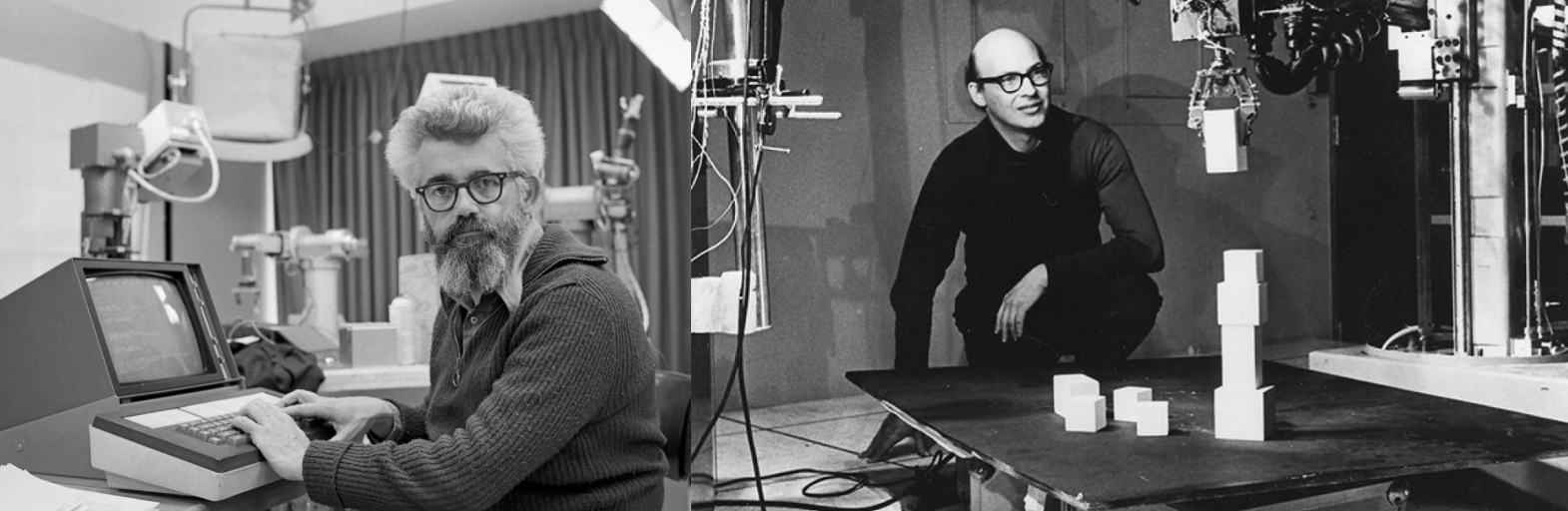
This week in The History of AI at AIWS.net – the MIT AI Lab was founded by John McCarthy and Marvin Minsky in 1959. This marked the beginning of coordinated AI research at MIT. The lab focused on researching and developing AI. The Lab went through several iterations and in 2003 merged with the Laboratory for Computer Science to become the MIT Computer Science and Artificial Intelligence Laboratory.
Marvin Minsky was an American cognitive and computer scientist. He penned the research proposal for the Dartmouth Conference, which coined the term “Artificial Intelligence”, and he was a participant in it when it was hosted in 1956. Minsky would make various contributions to the development of Artificial Intelligence. In terms of popular culture, he was an advisor to Stanley Kubrick’s acclaimed movie 2001: A Space Odyssey. He won the Turing Award in 1969.
John McCarthy was an American computer scientist. He, along with Minsky and others, co-wrote the proposal for the Dartmouth Conference, and participated in it. McCarthy also developed the Lisp programming language. Additionally, he also influenced various tasks in computer science. He spent most of his career at Stanford after working at Dartmouth and MIT. McCarthy won the Turing Award in 1971.
The History of AI Initiative considers the founding of the MIT AI Lab as an important event due to its role in the contribution to AI development. Furthermore, Marvin Minsky and John McCarthy are considered some of the founders of Artificial Intelligence research.
On this day and post, the HAI Initiative would like to wish readers a Merry Christmas and hope for the development of Artificial Intelligence to greater heights.

by Admin | Dec 18, 2020 | Chronicles, News
This week in The History of AI at AIWS.net – the Alvey Programme was launched by the British government in 1983. It is a project developed in response to Japan’s own Fifth Generation Computer project. There was no specific focus or directive, but rather the program was to support research in knowledge engineering in the UK.
Originally, the UK was invited to Japan’s FGP, and they created a committee chaired by John Alvey, a technology director at British Telecom. In the end, they rejected Japan’s invitation and formed the Alvey Programme. John Alvey was not involved in this initiative itself though.
This project was created in response to Japan’s Fifth Generation Computer program, funded by the Japanese Ministry of Trade and Industry in 1982. The goal of this program was to create computers with massively parallel computing and logic programming and to propel Japan to the top spots in advanced technology. This will then create a platform for future developments in AI. By the time of the program’s end, the opinion of it was mixed, divided between considering it a failure or ahead of its time.
Another program that rivalled the Alvey Programme was America’s Strategic Computing Initiative, founded in 1983 after the first AI winter in the 70s. The initiative supported projects that helped develop machine intelligence, from chip design to AI software. The DoD spent a total of 1 billion USD (not adjusted for inflation) before the program’s shutdown in 1993. Although the initiative failed to reach its overarching goals, specific targets were still met.
Although the results of the Alvey Programme and other computer and AI projects (Fifth Generation and SCI) in the 80s were mixed, they helped bring funding back to AI development after the first AI winter in the 70s. The History of AI marks the Alvey Programme as an important event in AI due to its marker in AI development in the 1980s.