
by Admin | Jan 8, 2021 | Chronicles, News
This week in The History of AI at AIWS.net – Joseph Weizenbaum was born on January 8th, 1923. Weizenbaum published the program ELIZA in 1966 which could mimic conversation with humans. Although Weizenbaum was considered a father of Artificial Intelligence, he criticised the field later in his life.
Joseph Weizenbaum was a German-American computer scientist. He was born in 1923 to Jewish parents in Germany and fled to the US in 1936. He studied at Wayne State University, which was interrupted by the outbreak of the Second World War, but he completed his B.S. there in 1946 and M.S. in 1950. He started working at MIT in 1964. There he developed ELIZA. In the 70s and 80s he casted some doubts on AI and computer, with his book Computer Power and Human Reason (1976) and an interview with MIT’s The Tech. In 2008, the International Society for Ethics and Information Technology established the Weizenbaum Award, named after him, for individuals that made significant contributions to information and computer ethics. Weizenbaum passed away in Germany in 2008.
ELIZA was a computer program developed at the MIT AI Lab between 1964 and 1966. It was named after the character Eliza Doolittle from the play Pygmalion by George Bernard Shaw. The program runs a DOCTOR script, and acts in the manner of a psychotherapist. ELIZA could simulate a conversation but wasn’t able to contextualised them. Weizenbaum’s purpose of developing the program was to demonstrate the superficiality of communication between humans and machines. ELIZA is one of the first examples of a chatbot.
Joseph Weizenbaum was a pivotal figure in the development of AI with his contribution of ELZIA. Thus, the HAI Initiative considers his birth to be a notable event in the history of AI.

by Admin | Jan 1, 2021 | Chronicles, News
Yesterday, the HAI board and initiative announced the HAI 2020 awards and nominations which can be read here in full.
This week in The History of AI at AIWS.net – the end of the first AI Winter in 1980. This was due to the adoption of “expert systems” into corporations in the 90s and Japan’s Fifth Generation Computer project.
Expert systems are computer systems that can emulate man’s decision-making abilities. They are designed to solve problems through reasoning and they can perform at the level of human experts. The first expert system was SAINT, developed by Marvin Minsky and James Robert Slagle. Lisp machines are designed to be able to run expert systems. Lisp machine runs the Lisp programming language, and in a way, it was one of the first commercial and personal workstation computer.
Japan’s Fifth Generation Computer program was created and funded by the Japanese Ministry of Trade and Industry in 1982. The goal of this program was to create computers with massively parallel computing and logic programming and to propel Japan to the top spots in advanced technology. This will then create a platform for future developments in AI. By the time of the program’s end, the opinion of it was mixed, divided between considering it a failure or ahead of its time.
The HAI initiative considers the end of the frst AI Winter as a significant marker in AI history. It ended the thaw in AI development and revitalised the field, leading to more pioneering and research. As we enter a new year, we would like to wish our readers a Happy New Year, and hope for the development of Artificial Intelligence to greater heights, as is what happened after an AI winter.

by Admin | Dec 30, 2020 | Chronicles
30.12.2020. Zlatko Lagumdzija
The History of AI event of 2020 – The Social Contract for the AI Age
Zlatko Lagumdzija
Former Prime Minister of Bosnia and Herzegovina
Member of World Leadership Alliance-Club de Madrid
Member of the History of AI Board
Social Contract for the AI Age can be named as the History of AI event of 2020 since it is offering transformative tools and means for creating complex elements and goals of great mosaic reflecting different perspectives in search for our prosperous and shared future.
Development of AI that is impacting our life and work with magnitudes bigger than any human invention in history is a clear sign of necessity and importance of a pioneering act such as the first Social Contract in the Internet and AI Age.
Fruits of Renaissance and Age of Enlightenment have been enjoyed by people because of great thinkers like Thomas Hobbes and Jean Jacques Rousseau who created the Social Contract concept as the leading doctrine of political legitimacy and platform for peace, security and democracy centuries ago.
Social Contract for the AI Age, as agreement among all stakeholders of society to work together for social benefit, is a comprehensive and impactful call to leaders to show wisdom and leadership using science and technology fruits in order to move our planet in the right direction.
Since September creation and adoption by 10 signatories coming from different backgrounds and experiences, under umbrella of the Boston Global Forum and AI World Society (AIWS), it has been endorsed, supported and called for implementation by the World Leadership Alliance – Club de Madrid and a long line of stakeholders from governments, academic, civil society and business leaders from various parts of the globe.
Social Contract for the AI Age is a pioneering, meaningful and impactful document since it is defining the purpose, vision and values that can be met by tools and means like AI is offering.
That is why Social Contract for the AI Age can help us to shape societies for a common purpose through transformative vision that transcends the technological features of AI and seeks to provide foundations for a progressive, new, better, and more prosperous society.
by Admin | Dec 31, 2020 | News
RELEASE: December 31, 2020
1200 EST / 1800 CET
AI World Society Announces
History of AI 2020 Awards
BOSTON – The AI World Society today announced the History of AI 2020 Awards. The HAI Awards recognize people and achievements in the AI world that are pioneering, meaningful, and influential.
The History of AI 2020 Awards for Achievement go to:
AlphaFold – the solution to a 50-year-old grand challenge in biology, developed by DeepMind. “This breakthrough demonstrates the impact AI can have on scientific discovery and its potential to dramatically accelerate progress in some of the most fundamental fields that explain and shape our world.”
“Artificial Intelligence and Democratic Values” – the first comparative study of AI policies and practices sets out a methodology to promote AI that is trustworthy and human-centric. Professor Mireille Hildebrandt called the report “a trove of materials to enable mutual learning strategies.” Gabriela Zanfir-Fortuna said the report is a “vital resource for global policymakers . . . comprehensive and incredibly valuable.”
Deep Understanding – a concept pioneered by Professor Judea Pearl for the development of AI systems that could minimize the creation of large data sets. Deep understanding challenges the common view that meaningful AI requires intensive data collection.
GPT-3 – a natural language program that produces news articles and technical manuals, creative essays, and computer code often difficult to distinguish from human output. GPT-3 also raises challenging ethical questions about machine-generated text.
Social Contract for the AI Age – a framework for a new social contract to ensure peace, security, and democracy in the modern era. The World Leadership Alliance-Club de Madrid, the largest association of former Presidents and Prime Ministers of democratic governments, have endorsed the Social Contract.
The History of AI 2020 Awards to Individuals go to:
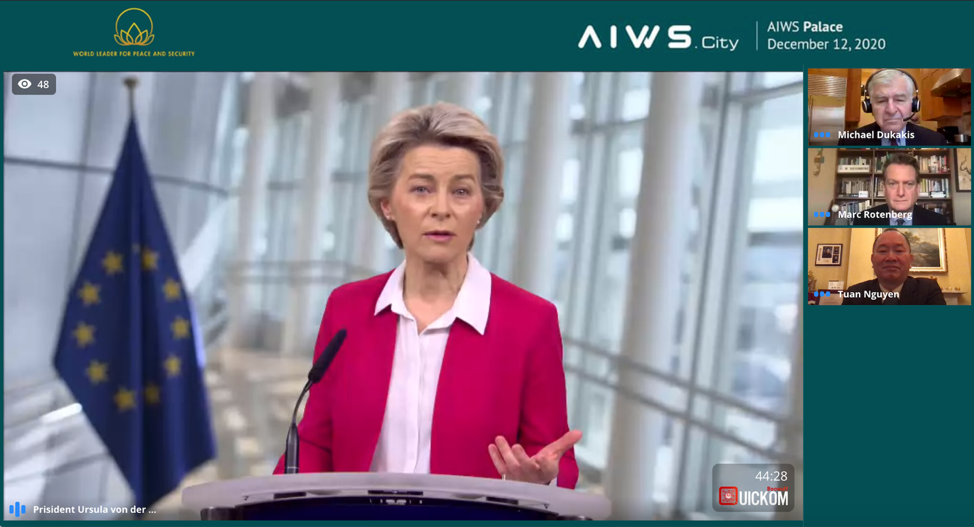
President Ursula von der Leyen – The incoming President of the European Commission, von der Leyen has led efforts to establish a regulatory framework for AI, opposed black box algorithms, and called for a Transatlantic Agreement on Artificial Intelligence, based on democratic values, including “human rights, pluralism, inclusion, and the protection of privacy.”
Joy Boulawamini – a Ghanaian-American computer scientist and digital activist based at the MIT Media Lab, Buolawamini founded the Algorithmic Justice League to challenge bias in AI systems. In 2020, her research helped persuade Amazon, IBM, and Microsoft to suspend facial recognition technology, one the most controversial applications of AI.
The History of AI 2020 Awards will be featured at the AI World Society City. The AI World Society (AIWS) City, established in collaboration with the World Leadership Alliance – Club de Madrid, and the United Nations Academic Impact, is a virtual digital city dedicated to the principle of the Social Contract for the AI Age.
CONTACT
Nguyen Anh Tuan, Co-Founder, AI World Society: [email protected]
Press Secretary Dick Pirozzolo: [email protected] / +1 617 959 4613
by Admin | Dec 30, 2020 | News
NOMINATION
History of AI 2020
Joy Buolamwini
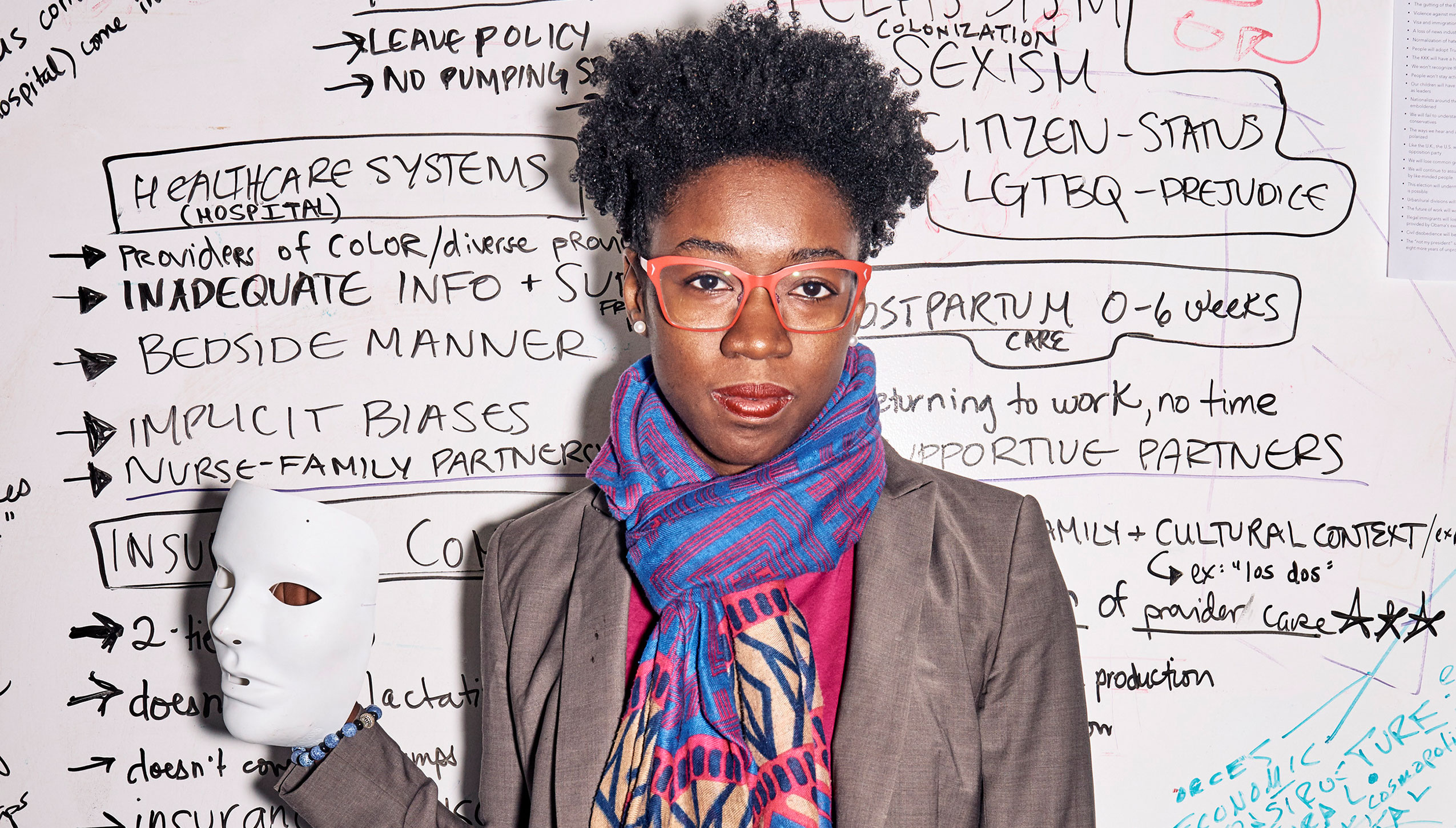
Joy Adowaa Buolamwini is a Ghanaian-American computer scientist and digital activist based at the MIT Media Lab. She founded the Algorithmic Justice League, an organisation that looks to challenge bias in decision making software.
In 2020, Buolamwini was on the front lines of campaigns in the United States and around the world to stop bias in AI systems. Her research helped persuade Amazon, IBM, and Microsoft to put a hold on facial recognition technology. Her 2020 TED Talk on algorithmic bias has over 1 million views. She was featured in the documentary film Coded Bias that premiered at
the 2020 Sundance Film Festival, that explores how algorithms encode and propagate bias.
Joy Buolamwini has testified before Congress about the dangers of facial recognition and she has called for a complete ban of police use of face surveillance. Her MIT thesis uncovered large racial and gender bias in AI services. Her research has been covered in over 40 countries, and as a renowned international speaker she has championed the need for algorithmic justice at the World Economic Forum and the United Nations. She serves on the Global Tech Panel convened by the vice president of European Commission to advise world leaders and technology executives on ways to reduce the harms of A.I.
As a creative science communicator, she has written op-eds on the impact of artificial intelligence for publications such as TIME Magazine and New York Times. Her spoken word visual audit “AI, Ain’t I A Woman?” shows AI failures on the faces of iconic women like Oprah Winfrey, Michelle Obama, and Serena Williams as well as the Coded Gaze short have been part of exhibitions ranging from the Museum of Fine Arts, Boston to the Barbican Centre, UK.
A Rhodes Scholar and Fulbright Fellow, she holds two masters degrees from Oxford University and MIT; and a bachelor’s degree in Computer Science from the Georgia Institute of Technology. Fortune Magazine named her to their 2019 list of world’s greatest leaders describing her as “the conscience of the A.I. Revolution.”
A brilliant researcher, a highly effective advocate, a creative communicator, Joy Boulamwini should be recognized for HAI 2020.
Marc Rotenberg