
by Admin | Dec 26, 2021 | Chronicles, News
This week in The History of AI at AIWS.net – Arthur Samuel popularises the term “machine learning” in 1959 in his article “Some Studies in Machine Learning Using the Game of Checkers”.
Arthur L. Samuel was an American computer scientist. He was a pioneer in the field of computer gaming and artificial intelligence. Born in 1901, he studied at the College of Emporia for his Bachelor and MIT for his Master. His Samuel Checkers-playing Program was one of the first successful self-learning programs and was a basis for this article that coined “machine learning”. He was notable for his works at IBM and Stanford. Samuel won the Computer Pioneer Award in 1987 for his contributions to computer science and AI. He passed away in 1990.
“Machine learning” is the study of computers that can self-improve through time and experience. It is often considered a part in the development of artificial intelligence. Although the study has existed before 1959, with this program and also developments such as the Dartmouth Conference, helped the field become more active. A subset of machine learning, deep learning, has also been gaining traction lately.
The article that he wrote on this program and “machine learning” can be read and downloaded here.
This is important to the history of AI in that it popularises the term “machine learning”, which is an important aspect of artificial intelligence. Arthur Samuel is also one of the pioneers in computer science and AI.


by Admin | Dec 19, 2021 | Chronicles, News
This week in The History of AI at AIWS.net – The Book of Why by Judea Pearl was published on 15 May, 2018. The book discusses causality and Bayesian probability, as well as their relations to fields such as AI and statistics.
Judea Pearl is a renowned Israeli-American computer scientist. He is a pioneer into Baynesian networks, probabilistic approaches to AI, and causal inference. He is also known for his other books, Probabilistic Reasoning in Intelligent Systems (1988) and Causality: Models, Reasoning, and Inference (2000). Professor Pearl won the Turing Award, one of the highest honours in the field of computer science, in 2011, for his works into AI through probabilistic and causal reasoning. He is a Chancellor’s Professor at UCLA.
The Book of Why (2018) can be bought through various booksellers such as Amazon and Barnes and Nobles, but further background information and supplementary materials can be read here.
Due to the impact that the book has, the History of AI initiative considers it an important marker in AI history. Professor Judea Pearl is one of the most influential computer scientists around the world. He is a Mentor of AI World Society Innovation Network (AIWS.net). Professor Pearl resides on the History of AI Board. He was honored as 2020 World Leader in AI World Society by Michael Dukakis Institute and the Boston Global Forum.

by Admin | Dec 10, 2021 | Chronicles, News
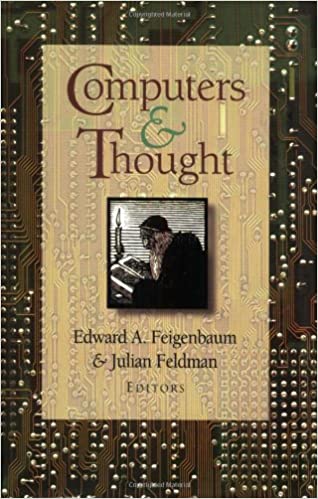
This week in The History of AI at AIWS.net – in 1963 Edward Feigenbaum and Julian Feldman published Computers and Thought, a book composed of articles on Artificial Intelligence, the first of its kind. Feigenbaum and Feldman edited and wrote some of the articles but they were not the the only contributors. Computers and Thought includes 20 articles from notable AI pioneers such as Alan Turing, Marvin Minsky, Allan Newell, Herbert Simon, and others.
Edward Feigenbaum is an American computer scientist focused on Artificial Intelligence. He studied at Carnegie Mellon University for both his B.S. and Ph.D., with Herbert Simon, an AI pioneer, as his doctoral advisor. He would go on to work at UC Berkeley and Stanford, the latter where he became Professor Emeritus of Computer Science (since 2000). Feigenbaum received the ACM Turing Award in 1994 with Raj Reddy for pioneering in AI and demonstrating its commercial potential.
Julian Feldman is an American computer scientist with an eye on Artificial Intelligence. Feldman studied at the University of Chicago for his undergrad; received an M.A. in political science; before going to Carnegie Mellon’s Graduate School of Industrial Administration for his Ph.D. He held a tenured position at UC Berkeley, before leaving it to help build UC Irvine, where he would create its Information and Computer Sciences department, the first ICS school in the UC system. Feldman also wrote papers and articles on connectionism, a fairly contentious topic within AI and computer science.
The HAI Initiative considers this book an important event in the history of AI due to its culmination of various thoughts on AI from its pioneers. Feigenbaum and Feldman themselves are also notable figures in the development of artificial intelligence.
by Admin | Dec 3, 2021 | Chronicles, News
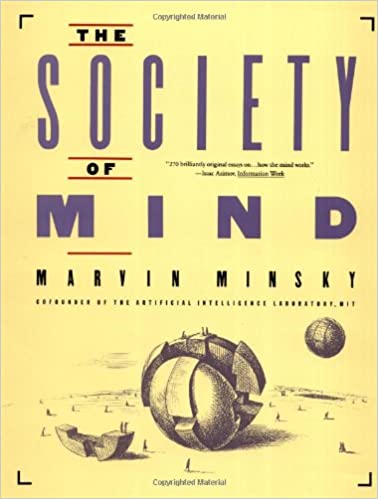
This week in The History of AI at AIWS.net – Marvin Minsky publishes The Society of Mind in 1987. This book is a theoretical description of the mind as a collection of cooperating agents.
Marvin Minsky was an American cognitive and computer scientist. He penned the research proposal for the Dartmouth Conference, which coined the term “Artificial Intelligence”, and he was a participant in it when it was hosted in 1956. Minsky would also make significant contributions to artificial intelligence, both in the study of the field and in popular culture. He won the Turing Award in 1969.
The Society of Mind is a book on the theory of “Society of Mind”, which came out of Marvin Minsky’s own thinking. In the book, Minsky describes the mind as a collection of mindless but cooperating “agents”. He first started developing the theory with Seymour Papert in the 1970s, but worked on it and published the book at a later point. The book is viewable at the Internet Archive.
Although the book does not directly reference or influence the development of artificial intelligence, it displays the theoretical dimensions of Marvin Minsky, the AI pioneer. The book also gives a glimpse into Minsky’s thinking in building artificial intelligence. Thus, the HAI initiative considers this an event in the history of AI.

by Admin | Nov 26, 2021 | Chronicles, News
This week in The History of AI at AIWS.net – the Alvey Programme was launched by the British government in 1983. It is a project developed in response to Japan’s own Fifth Generation Computer project. There was no specific focus or directive, but rather the program was to support research in knowledge engineering in the UK.
Originally, the UK was invited to Japan’s FGP, and they created a committee chaired by John Alvey, a technology director at British Telecom. In the end, they rejected Japan’s invitation and formed the Alvey Programme. John Alvey was not involved in this initiative itself though.
This project was created in response to Japan’s Fifth Generation Computer program, funded by the Japanese Ministry of Trade and Industry in 1982. The goal of this program was to create computers with massively parallel computing and logic programming and to propel Japan to the top spots in advanced technology. This will then create a platform for future developments in AI. By the time of the program’s end, the opinion of it was mixed, divided between considering it a failure or ahead of its time.
Another program that rivalled the Alvey Programme was America’s Strategic Computing Initiative, founded in 1983 after the first AI winter in the 70s. The initiative supported projects that helped develop machine intelligence, from chip design to AI software. The DoD spent a total of 1 billion USD (not adjusted for inflation) before the program’s shutdown in 1993. Although the initiative failed to reach its overarching goals, specific targets were still met.
Although the results of the Alvey Programme and other computer and AI projects (Fifth Generation and SCI) in the 80s were mixed, they helped bring funding back to AI development after the first AI winter in the 70s. The History of AI marks the Alvey Programme as an important event in AI due to its marker in AI development in the 1980s.

by Admin | Nov 19, 2021 | Chronicles, News
This week in The History of AI at AIWS.net – DARPA founded the Strategic Computing Initiative to fund research of advanced computer hardware and artificial intelligence in 1983. DARPA stands for the Defense Advanced Research Projects Agency, a research and development agency founded by the US Department of Defense in 1958 as the ARPA. Although its aim was for usage in the military, many of the innovations the agency funded were beyond the requirements for the US military. Some technologies that emerged from the backing of DARPA are computer networking and graphical user interfaces. DARPA works with academics and industry and report directly to senior DoD officials.
The Strategic Computing Initiative was founded in 1983, after the first AI winter in the 70s. The initiative supported projects that helped develop machine intelligence, from chip design to AI software. The DoD spent a total of 1 billion USD (not adjusted for inflation) before the program’s shutdown in 1993, even though there were several cuts in the late 80s. Although the initiative failed to reach its overarching goals, specific targets were still met.
This project was created in response to Japan’s Fifth Generation Computer program, funded by the Japanese Ministry of Trade and Industry in 1982. The goal of this program was to create computers with massively parallel computing and logic programming and to propel Japan to the top spots in advanced technology. This will then create a platform for future developments in AI. By the time of the program’s end, the opinion of it was mixed, divided between considering it a failure or ahead of its time.
Although the results of the SCI and other computer/AI projects in the 80s were mixed, they helped brought funding back to AI development after the first AI winter in the 70s. The History of AI marks the Strategic Computer Initiative as an important event in AI due to its revival of AI in the US. The SCI towards its ends also indicated a second AI winter.