by Admin | Jan 30, 2022 | Chronicles, News
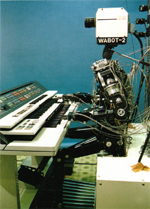
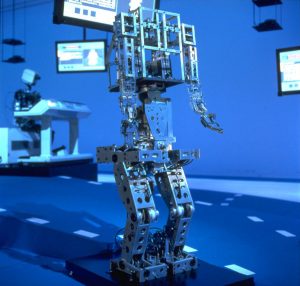
This week in The History of AI at AIWS.net – Waseda University built WABOT-2 in 1984. A follow up to the WABOT-1 they built in 1973, this robot was also anthropomorphic, but improvements were made.
The WABOT-2 was a follow-up to the WABOT-1 project. This iteration can now play music of average difficulty on an electronic organ. It was now able to converse with another person as well. In addition, it now has a camera for its head. A contrast with WABOT-1 is that WABOT-2 is considered a “specialist robot” instead of a “versatile robot”.
After the success of WABOT-1 in 1973, Waseda University picked the project back up in 1980. The project developed by a study group at the School of Science & Engineering. The goal of this project was to create an anthropomorphic robot that could perform intelligent tasks such as performing music. Thus, WABOT-2 became more specialised, rather than the versatility of WABOT-1
Similar to the WABOT-1, WABOT-2 was mainly a robotic project. Still, the WABOT-2 helped develop AI in improving the WABOT’s ability to conversate. The HAI initiative considers this an event, as with the first one, in the History of AI due to its contributions to the development of AI.
by Admin | Jan 21, 2022 | Chronicles, News
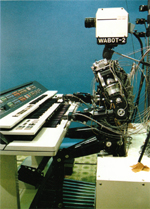
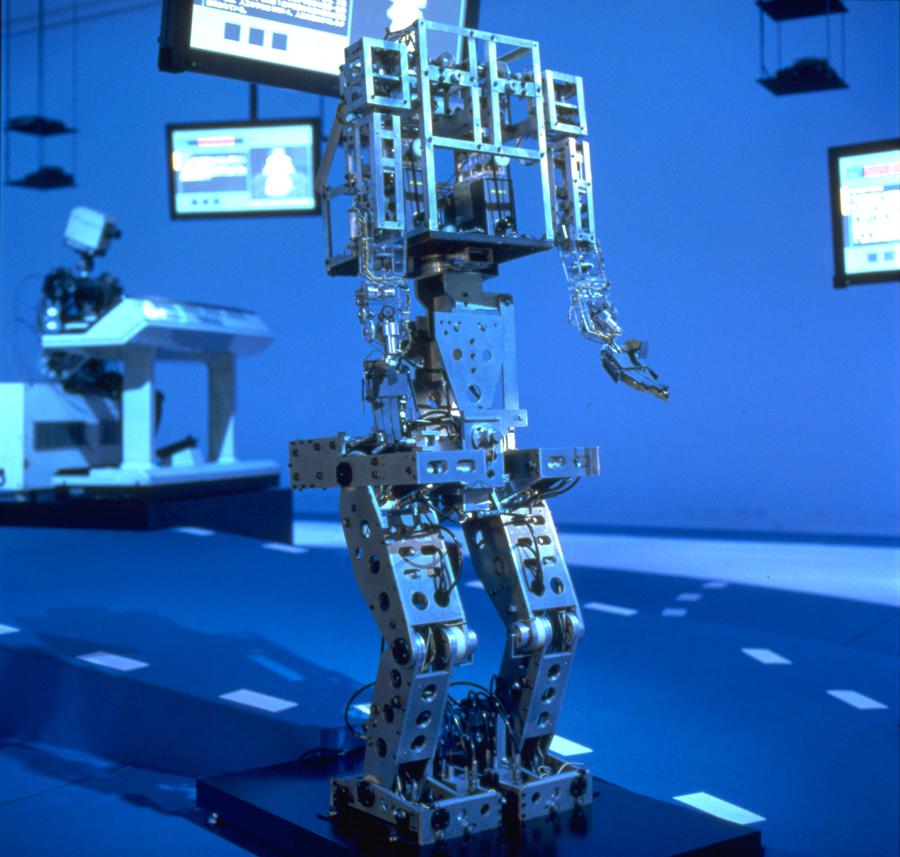
This week in The History of AI at AIWS.net – Waseda University built WABOT-1 in 1973. It was the first full-scale anthropomorphic robot, with a climb-control system, a vision system, and a conversation system.
The WABOT-1 was the first of its kind. It was able to communicate with a person in Japanese, as well as measure distance and direction. WABOT (WAseda roBOT) was able to walk and grab objects. It had the mental faculty of a one-and-a-half-year-old child. The robot had the WAM-4 for its hands, and the WL-5 for its legs.
The WABOT project was initiatived at Waseda University in Tokyo, Japan in 1967. Development did not fully start until 1970, and was not finished until 1973. The project was under the direction of Ichiro Kato at the School of Science & Engineering. In the 80s, Waseda University would reiterate its works on WABOT-1 with a new robot, the WABOT-2.
While the WABOT-1 was a mainly robotic project, its conversation system creates for it an important connection to the field of AI. The HAI initiative considers this an event in the History of AI due to its contributions to the development of AI.
by Admin | Jan 15, 2022 | Chronicles, News
This week in The History of AI at AIWS.net – Unimate, an industrial robot developed in the 50s, becomes the first to work in New Jersey in 1961.
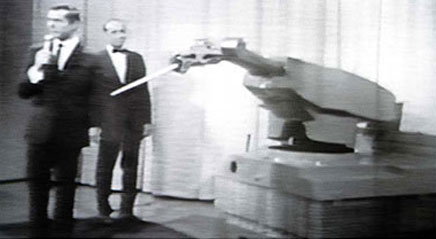
Unimate was invented by George Davol, who filed the patent in 1954. Davol met Joseph Engelberger in 1956, and the two paired up to found Unimation, the first robot manufacturing company. Davol and Engelberger promoted Unimate at The Tonight Show. Engelberger then exported industrial robotics to outside the US as well.
The Unimate worked at a General Motors assembly line at the Inland Fisher Guide Plant in New Jersey. The robot transported die castings from asssembly lines and welded parts on autos. It did this job because it was considered dangerous for human workers, due workplace hazards such as toxic fumes. The robot had the appearance of a box connected to an arm, with systematic tasks stored in a drum memory.
Although this machine was not directly connected to Artificial Intelligence, it was a precursor to developments in that field. By implementing a robot that can do tasks, this project was taking the first steps towards AI. Thus, the HAI initiatve considers this a milestone in the History of AI.


by Admin | Jan 9, 2022 | Cornerstones, News
Delphi, a MIT-Janssen’s COVID-19 Forecast Model – MIT researchers and scientists at Janssen Research & Development (Janssen) leveraged real-world data and applied artificial intelligence and machine learning (AI/ML) to help guide the company’s research efforts into a potential vaccine.
When the World Health Organization declared COVID-19 a pandemic in March 2020 and forced much of the world into lockdown, Bertsimas, who is also the faculty lead of entrepreneurship for the Jameel Clinic, brought his group of 25-plus doctoral and master’s students together to discuss how they could use their collective skills in machine learning and optimization to create new tools to aid the world in combating the spread of the disease.
The group started tracking their efforts on the COVID Analytics platform, where their models generate accurate real-time insight into the pandemic. One of the group’s first projects was charting the progression of COVID-19 with an epidemiological model they developed named DELPHI, which predicts state-by-state infection and mortality rates based upon each state’s policy decision using an expanded SEIR model. A key innovation of the model is capturing the behaviors of people related to measures put into place during the pandemic, such as lockdowns, mask-wearing and social distancing, and the impact these had on infection rates.
“By June or July, we were able to augment the model with these data. The model then became even more accurate,” Bertsimas says. “We also considered different scenarios for how various governments might respond with policy decisions, from implementing serious restrictions to no restrictions at all, and compared them to what we were seeing happening in the world. This gave us the ability to make a spectrum of predictions. One of the advantages of the DELPHI model is that it makes predictions on 120 countries and all 50 U.S. states on a daily basis.”

by Admin | Jan 7, 2022 | Chronicles, News
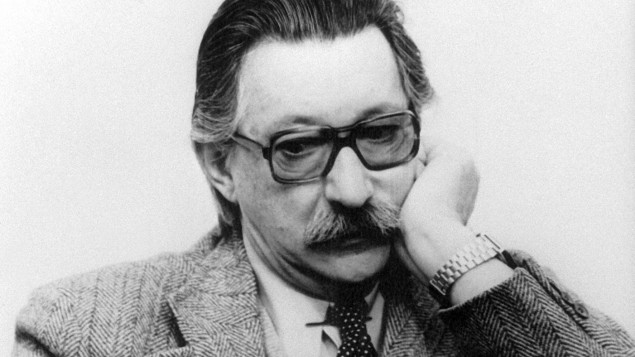
This week in The History of AI at AIWS.net – Joseph Weizenbaum was born on January 8th, 1923. Weizenbaum published the program ELIZA in 1966 which could mimic conversation with humans. Although Weizenbaum was considered a father of Artificial Intelligence, he criticised the field later in his life.
Joseph Weizenbaum was a German-American computer scientist. He was born in 1923 to Jewish parents in Germany and fled to the US in 1936. He studied at Wayne State University, which was interrupted by the outbreak of the Second World War, but he completed his B.S. there in 1946 and M.S. in 1950. He started working at MIT in 1964. There he developed ELIZA. In the 70s and 80s he casted some doubts on AI and computer, with his book Computer Power and Human Reason (1976) and an interview with MIT’s The Tech. In 2008, the International Society for Ethics and Information Technology established the Weizenbaum Award, named after him, for individuals that made significant contributions to information and computer ethics. Weizenbaum passed away in Germany in 2008.
ELIZA was a computer program developed at the MIT AI Lab between 1964 and 1966. It was named after the character Eliza Doolittle from the play Pygmalion by George Bernard Shaw. The program runs a DOCTOR script, and acts in the manner of a psychotherapist. ELIZA could simulate a conversation but wasn’t able to contextualised them. Weizenbaum’s purpose of developing the program was to demonstrate the superficiality of communication between humans and machines. ELIZA is one of the first examples of a chatbot.
Joseph Weizenbaum was a pivotal figure in the development of AI with his contribution of ELZIA. Thus, the HAI Initiative considers his birth to be a notable event in the history of AI.
by Admin | Jan 2, 2022 | Chronicles, News
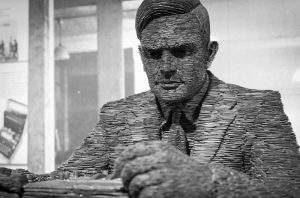
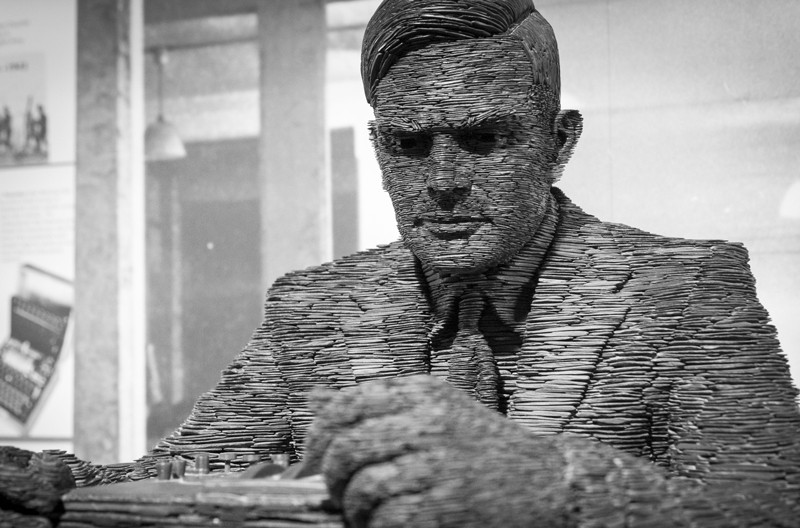
This week in The History of AI at AIWS.net – “Computing Machinery and Intelligence” by Alan Turing was published in the Mind quarterly academic journal in October 1950. It was the first instance that the “Turing test” was introduced to the public. The paper takes the question “Can machines think” and breaks it down. The paper also addresses 9 objections and arguments against Artificial Intelligence – Religious, “Heads in the Sands”, Mathematical, etc. Turing wrote about a potential “Learning Machine” that could successfully bypass the Turing test.
The Turing test, also known as the Imitation game, can be used to tell machines from humans. It poses a hypothetical, where a human evaluator would judge conversations between a machine designed for human-like responses and a human; if the evaluator cannot identify the machine from the human, then the machine passed the test. The test has proven to be both influential and controversial.
Alan Turing was a British computer scientist and cryptanalyst. He developed the Turing machine, a model of a general-purpose computer, in 1936. During the Second World War, he worked at Bletchley Park (Government Code and Cyper School) as a codebreaker for the United Kingdom. At his time here, he would play a critical role in solving Enigma, Germany’s wartime infamous encryption system. Solving Enigma helped turning the tide of the war in favour of the Allies. After the war, he would go on to develop the Turing test in 1950. Alan Turing is widely considered the father of modern Artificial Intelligence, as well as being highly influential in theoretical computer science. The “Nobel Prize of Computing”, the ACM Turing Award, is named after him.
The History of AI initiative considers this event to be important due to “Computing Machinery and Intelligence” being a seminal paper in regards to both Computer Science and AI.
The paper introduces many new concepts in CS and AI to the general public. Alan Turing is a pivotal figure in the development of Artificial Intelligence, computing, and machine learning as well. Thus, the publication of this paper is a critical moment in the History of AI.